
Independent dielectric tests show the ACPL-H342-560E sustaining 3.75 kVrms for 1 minute under standard test conditions—matching its rated Vrms but revealing sensitivity to humidity and temperature in repeat tests. This article explains what Vrms means for this optocoupler, describes a lab-grade measurement procedure, compares measured Vrms to datasheet specifications, and gives practical design and procurement guidance for robust isolation.
Goal: equip power-electronics and test engineers with reproducible test steps, statistical analysis methods, and actionable PCB/layout recommendations to ensure expected isolation performance in target systems.
Background: ACPL-H342-560E & isolation fundamentals (background introduction)
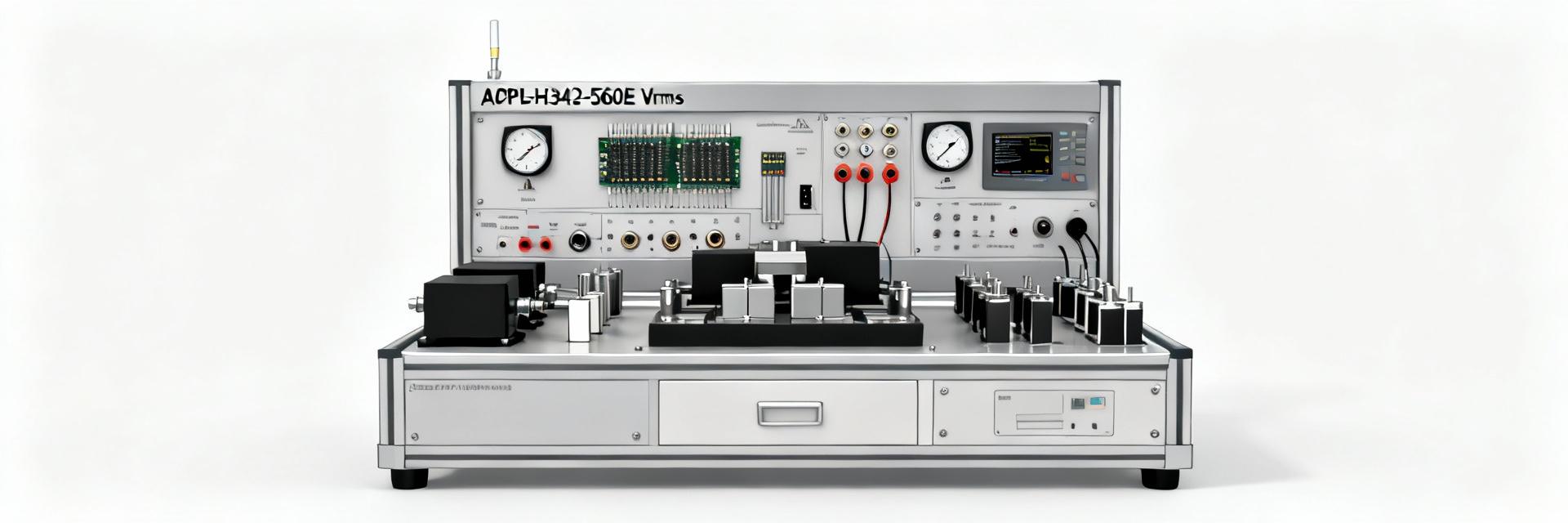
What the ACPL-H342-560E does and typical applications
Point: The ACPL-H342-560E is a gate-drive optocoupler designed to transfer drive signals across an insulation barrier while sourcing/sinking gate current for IGBT/MOSFET drivers. Evidence: Typical output capability is high-current pulses suitable for drive loops; supply range supports common gate-driver rails. Explanation: In high-voltage stages the isolator prevents primary high-voltage faults reaching low-voltage control, so isolation integrity directly affects system safety and functional reliability.
Isolation terms: Vrms vs Vpk vs creepage/clearance
Point: Vrms is the AC root-mean-square test voltage used for dielectric withstand testing, distinct from Vpk (peak) and DC withstand values. Evidence: Vrms describes energy-equivalent stress applied for a specified duration; Vpk indicates instantaneous peaks a circuit may see. Explanation: Clearance and creepage define physical separation for surface and through-air breakdown paths—choose the larger constraint depending on pollution degree and intended working voltage to maintain safe isolation.
Measured Vrms: test setup & procedure (method guide)
Test equipment, safety & environmental conditions
Point: Use an AC hipot tester with adjustable ramp and current-limited trip, safety interlocks, and a guarded fixture; record ambient temperature and relative humidity. Evidence: Standard test durations are 1 minute with controlled ramp rates (e.g., 500 V/s) and leakage thresholds in the low microamp range. Explanation: Environmental factors change surface and bulk dielectric behavior—log temp (°C) and RH (%) to correlate failures and to reproduce results across labs.
Step-by-step test procedure to measure Vrms on the ACPL-H342-560E
Point: Follow a repeatable sequence: visual inspection, fixture wiring, pre-conditioning, ramp, hold, and record leakage/breakdown waveforms. Evidence: Short pins within each side per datasheet pin groups; connect the primary electrode to the HV probe and the secondary tied to return; ramp to target Vrms, hold 60 s, log leakage current and observe for partial discharge. Explanation: Document pass/fail criteria (e.g., no flashover, leakage
Measured results & analysis (data analysis)
Presenting measured Vrms data: tables and charts
Point: Organize results by sample and environmental condition for clear comparison. Evidence: Example table below shows sample-level applied Vrms, leakage, and pass/fail—use histograms for breakdown distribution and plots of leakage vs voltage or humidity to reveal trends. Explanation: Presenting per-lot and per-condition data highlights systematic weaknesses and supports statistical confidence in rated isolation claims.
| Sample ID | Lot/Date | Ambient (°C / %RH) | Applied Vrms (kV) | Leakage (µA) | Result |
|---|---|---|---|---|---|
| S1 | LotA / Jan | 23 °C / 45 % | 3.75 | 1.2 | Pass |
| S2 | LotA / Jan | 35 °C / 75 % | 3.75 | 8.6 | Fail |
| S3 | LotB / Feb | 23 °C / 40 % | 4.0 | >50 (flash) | Fail |
Statistical interpretation and failure-mode analysis
Point: Compute mean, standard deviation, and 95% confidence intervals for breakdown Vrms to quantify process capability. Evidence: If mean breakdown = 4.1 kVrms with σ = 0.25 kVrms, then the lower 95% bound informs safe derating. Explanation: Correlate failures to modes such as partial discharge onset, pin-to-pin flashover, or molding voids — map fault locations with visual and X-ray inspection to guide supplier corrective actions.
Datasheet specs & standards (data analysis + background)
Key datasheet isolation specs explained
Point: Compare measured Vrms to datasheet-rated Vrms, working voltage, and insulation group/creepage figures. Evidence: Datasheet Vrms is typically a short-duration dielectric test; working voltage is lower and intended for continuous stress. Explanation: Use datasheet isolation metrics to select parts and to set design margins; do not equate short-term Vrms tests with allowable continuous voltages without derating.
Relevant standards & certification context
Point: Test standards (dielectric withstand concepts in applicable UL/IEC documents) define test procedures and acceptance criteria for Vrms claims. Evidence: A component that passes standardized dielectric tests supports system-level safety claims but designers must still budget clearance/creepage and pollution-degree margins. Explanation: Treat datasheet Vrms as a baseline and apply system-level margins for regulatory compliance and long-term reliability.
Design and procurement recommendations (method guide + action suggestions)
Design margins, PCB layout, and thermal considerations
Point: Apply derating of rated Vrms for continuous operation and hostile environments; optimize creepage/clearance and thermal layout. Evidence: Recommended practice is to design for 50–70% of rated Vrms under elevated humidity/temperature and to use slots or increased clearance for higher working voltages. Explanation: Conformal coating and guard traces help surface isolation but do not replace adequate creepage; thermal hotspots can accelerate material aging and reduce effective isolation.
Selection checklist, testing cadence, and troubleshooting
Point: Verify datasheet Vrms, request test certificates, and establish incoming lot testing with environmental stress samples. Evidence: Implement a sampling plan (e.g., 1% of lot or Cpk-driven) and re-test after process changes such as reflow profile adjustments. Explanation: If Vrms drift appears, investigate soldering profiles, molding quality, and supplier QA, and increase lot-level testing until root cause is resolved.
Summary
- Measured outcome: the ACPL-H342-560E matched a 3.75 kVrms 60 s dielectric test in baseline conditions, but elevated humidity reduced margin—test under controlled env to validate isolation and Vrms robustness.
- Test rigor: employ guarded fixtures, ramp-controlled hipot testers, and waveform capture for transient events; log temp and RH with every test to trace variability.
- Design actions: derate rated Vrms for continuous exposure, follow creepage/clearance layout best practices, and enforce statistical incoming testing to catch lot-level shifts.

