
06035A330KAT Datasheet: Part Overview (Background)
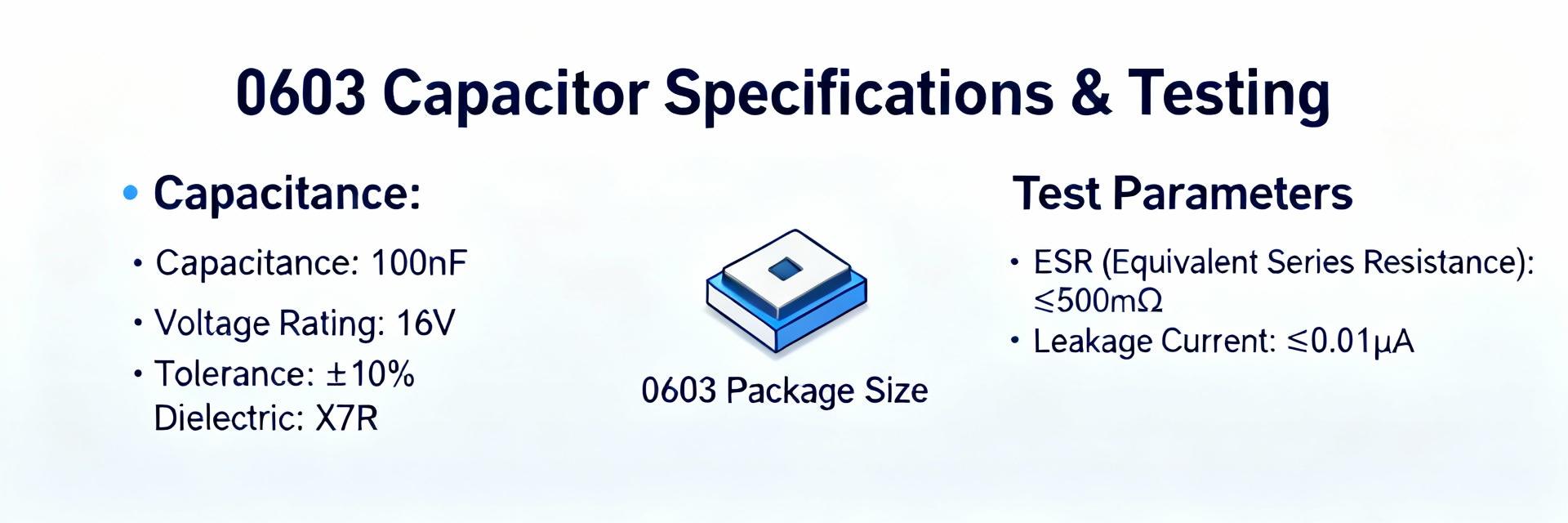
Part Identifiers & Ordering Information
Point: The full part identifier encodes package, dielectric, and tolerance information. Evidence: standard manufacturer coding lists package (0603), capacitance code, and tolerance suffix in the ordering string; packaging codes denote reel or tape. Explanation: when ordering, verify the full ordering string, packaging quantity, and lot/date code on the supplier paperwork; confirm MOQ and pack sizes with the supplier and note lot/date on shipment labels. (See 06035A330KAT specs in official datasheet for exact codes.)
Typical Applications & Target Use-cases
Point: This 0603 capacitor is commonly used for decoupling, filtering, and timing networks near IC Vdd rails. Evidence: package and dielectric choices make it suitable across typical low-voltage DC rails and mid-band AC filtering. Explanation: before selection, engineers should confirm three checks: rated voltage meets peak system stress, capacitance tolerance fits the application, and ESR is acceptable for transient suppression.
Verified Electrical & Mechanical Specs (Data Analysis)
Electrical Specifications
Point: Key electrical parameters must be compiled from the manufacturer datasheet and verified test runs. Evidence: datasheet provides nominal capacitance, tolerance, rated voltage, ESR/DF under specified frequency and temperature conditions. Explanation: use the table below to capture the parameter name, typical datasheet value descriptor, and the test condition to reference when comparing parts or running qualification tests.
| Parameter | Typical Datasheet Note | Test Condition / Comment |
|---|---|---|
| Nominal Capacitance | See manufacturer value (coded in part number) | Measure at 1 kHz unless otherwise specified |
| Tolerance | Manufacturer-specified tolerance (e.g., ±X%) | Verify at 25°C, as-stated on datasheet |
| Rated Voltage | Refer to part ordering code | Do not exceed DC bias limits; derate per datasheet |
| ESR / Dissipation Factor | Datasheet provides DF or ESR at specified freq/temp | Record frequency and temperature for comparison |
| Temperature Coefficient | Listed per dielectric class | Use for capacitance-vs-temperature planning |
Mechanical Dimensions & Reliability Ratings
Point: Mechanical specs determine footprint compatibility and assembly risk. Evidence: package is 0603; datasheet lists exact pad recommendations, thickness, and recommended land pattern. Explanation: engineers should apply datasheet land-pattern callouts, follow recommended pad fillets, and note moisture sensitivity level and operating temperature range; add an annotated footprint diagram with alt text that includes the main part identifier.
Independent Test Data & Performance Summary
Test Methods & Measurement Conditions
Point: Independent verification requires clear, repeatable test methods. Evidence: credible test protocols log instruments used, sample size, frequency points, ambient temperature, and number of reflow cycles. Explanation: when assembling independent test data, document instrument model, calibration status, sample lot, measurement frequencies, ambient conditions, reflow profile used, and pass/fail criteria so results are traceable and comparable.
Key Test Results & Interpretation
Point: Test results should summarize measured capacitance spread, ESR vs. frequency, thermal stability, and any observed failure modes.
Evidence: typical independent test datasets include capacitance vs. temperature curves, ESR vs. frequency sweeps, and reflow reliability outcomes. Explanation: interpret variances against tolerance bands—deviations within the tolerance window are acceptable; ESR increases that affect decoupling should be quantified and, if >X% from nominal (per design tolerance), flagged for mitigation.
Footprint, Assembly & Soldering Guidelines
Recommended PCB Footprint and Placement Rules
Point: Correct land pattern and placement avoid tombstoning and mechanical stress. Evidence: manufacturer-recommended pad dimensions, stencil apertures, and placement orientation reduce assembly defects. Explanation: use the datasheet land pattern, set stencil aperture to cover pad area recommended, apply a symmetric paste release for 0603, select nozzle size that minimizes suction deformation, and orient parts consistently; include a DFM checklist covering pad clearance, thermal relief, and placement accuracy.
Soldering Profile, Reflow Limits & Cleaning
Point: Reliable solder joints depend on compliant reflow profiles and handling. Evidence: datasheet lists recommended ramp, time above liquidus, peak temperature, and max reflow cycles; moisture sensitivity guidance affects baking and handling. Explanation: follow vendor peak temperature limits, limit reflow cycles as specified, use no-clean flux where recommended, and perform post-reflow inspection for tombstoning, insufficient wetting, and solder fillet quality.
Cross-reference, Selection Tips & Procurement Checklist
Equivalent Parts & Substitution Notes
Point: Substitutes must match electrical and mechanical constraints, not just capacitance. Evidence: equivalent parts only acceptable when capacitance, rated voltage, ESR behavior, package, and dielectric class align. Explanation: verify full datasheets side-by-side, obtain sample parts for bench test, and watch for subtle differences such as dielectric temperature coefficient or DC-bias characteristics that can change circuit behavior.
Final QA & Buying Checklist for Engineers
- Lot Traceability: Ensure documentation links back to original manufacturing batch.
- RoHS Compliance: Verify environmental standards claims.
- Sample Reports: Request representative test parts for critical builds.
- Search Terms: Suggested long-tail terms: “06035A330KAT test data reliability” and “06035A330KAT assembly tips”.
Summary
- Where to find verified info: consult the official manufacturer datasheet and the consolidated test-report summary for validated parameter comparisons.
- Key performance metrics: prioritize rated voltage, capacitance tolerance, and ESR/DF under specified frequency and temperature.
- Assembly tips: use the recommended 0603 land pattern, symmetric paste release, and adhere to datasheet reflow limits.
- Procurement QA steps: demand lot traceability, sample test reports, and moisture sensitivity documentation before production.
Call to Action: Download the full verified datasheet and request independent test reports when qualifying parts for production builds to reduce risk and speed time to volume.

