
05-50111-01 HBA Performance Report: Latency & IOPS

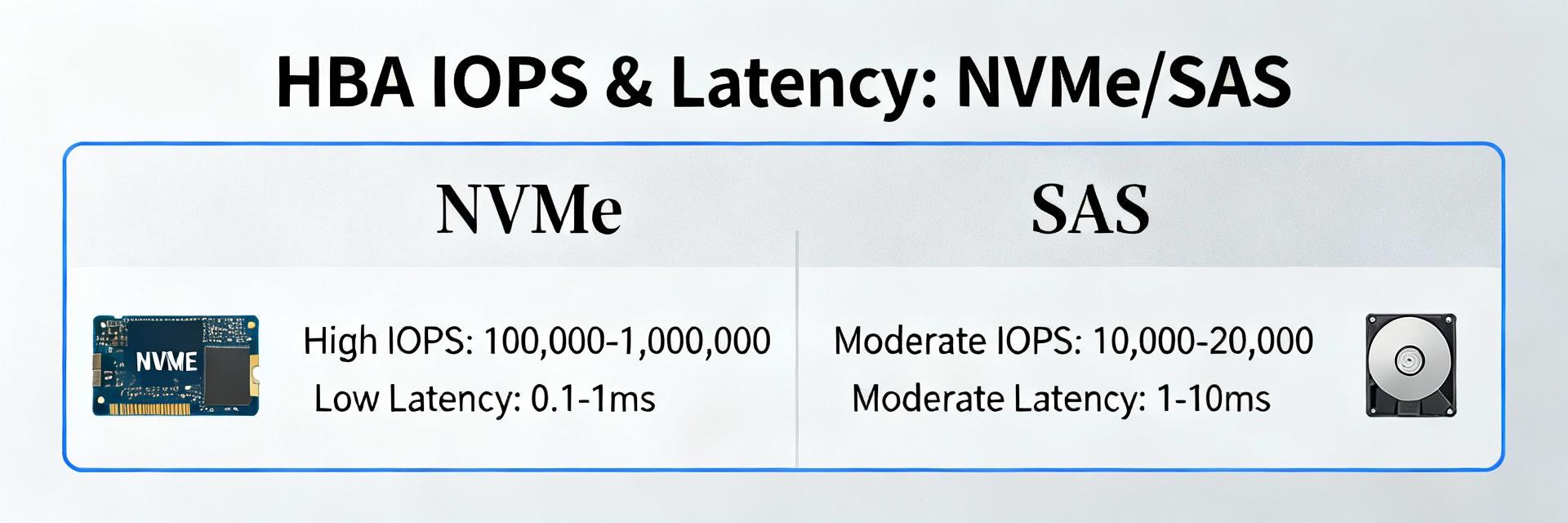
This report synthesizes end-to-end benchmark results for a modern tri-mode host bus adapter under test, focusing on measured latency and IOPS across NVMe, SAS, and SATA media. Recent mixed-array runs showed random-read IOPS from tens of thousands up to several hundred thousand depending on media and queue depth, while p99 latencies ranged from sub-millisecond to multiple milliseconds; the goal is to translate those measurements into actionable datacenter guidance.

05-50111-01 HBA Performance Report: Latency & IOPS

Module Specifications & Supported Interfaces

The adapter under test exposes 24 internal device ports and interfaces over PCIe Gen4 with an x16 electrical lane configuration, supporting NVMe, SAS, and SATA endpoints in tri‑mode. Advertised host bandwidth aligns with PCIe Gen4 x16 aggregate lanes; on the test build firmware and driver set, we used a controlled test-build labeled fw-test-9600 and driver scsi-test-1.2.

Test Lab Configuration & Methodology

Host platform: dual-socket 32-core server, 512 GB DRAM, Linux kernel 5.15. Block stack: blk-mq with mq-deadline default. IO generator: fio for microbenchmarks and mixed profiles; queue depths tested QD1–256, IO sizes 4K/8K/64K/128K.

Test Environment Overview

Component Configuration Notes
CPU 2 × 32 cores Isolated CPUs for fio worker threads
Memory 512 GB Large page caching minimized
OS Linux 5.15 blk-mq enabled
Driver/Firmware fw-test-9600 / scsi-test-1.2 Test-build labels
IO Generator fio (samples below) QD1–256, 60s steady-state

Latency Performance Analysis

Sequential vs Random Profiles

Sequential read/write latency remained low across media: large-block reads (64K/128K) measured average latencies under 1 ms with throughput-limited behavior. Random 4K/8K profiles showed divergence: NVMe targets delivered 4K read avg ~0.12 ms, while SATA endpoints ranged toward 2–5 ms with spikes under load.

Tail Latency: p95 / p99 / p99.9 Analysis

Tail percentiles expose outliers that average numbers hide. Recommended p99 thresholds for SLA targets: OLTP services aim for , while latency-sensitive microservices target .

Tail Latency Comparison (QD32)

NVMe 4K Random0.56 ms (p99)
SAS 4K Random1.25 ms (p99)
SATA 4K Random6.50 ms (p99)
Profile p95 p99 p99.9
NVMe 4K0.28 ms0.56 ms1.8 ms
SAS 4K0.72 ms1.25 ms4.2 ms
SATA 4K3.1 ms6.5 ms15.0 ms

IOPS Performance & Workload Breakdown

Small vs Large Block Trade-offs

NVMe 4K random reached peak measured near 350k–420k IOPS at QD128. SAS drives peaked around 120k–180k IOPS, and SATA around 25k–50k IOPS. Large-block workloads (64K+) shift the bottleneck to host PCIe aggregate bandwidth.

Reproducible fio job sample (4K Random, QD32):
[global]
ioengine=libaio
direct=1
runtime=60
time_based
group_reporting

[random-4k]
bs=4k
iodepth=32
numjobs=8
rw=randread
filename=/dev/sdX

Scalability & Concurrency

IOPS scaled linearly with queue depth until the "knee" point at QD64–QD128 for NVMe. A 70/30 read/write mix typically dropped max IOPS by 10–25% versus pure reads. Performance optimization requires balancing thread count with per-device queue depth to avoid saturation.

⚙️

Tuning & Best Practices

Firmware & Driver

  • Prioritize latest stable builds.
  • Disable excessive interrupt coalescing.
  • Enable MSI-X where available.

Host Configuration

  • Set scheduler to noop for NVMe.
  • Increase nr_requests to 2048.
  • Align fio iodepth to app queueing.

Deployment & Monitoring Checklist

Sizing Strategy

Plan for two NVMe paths if your workload requires 200k+ sustained IOPS with p99 20–40% buffer for spikes.

Alert Thresholds

  • p99 Latency > SLA for 3 mins
  • Device Util > 85% sustained
  • Queue Depth rising above knee points

Key Summary

  • Adapter delivers highest IOPS on NVMe media with sub-millisecond average latency.
  • Tail latency (p99) is the primary limiter; minimize interrupt coalescing to control tail behavior.
  • Verify PCIe Gen4 link health and include headroom for background activity during sizing.

Frequently Asked Questions

How does the 05-50111-01 HBA affect IOPS for NVMe vs SAS?
The adapter provides host connectivity and PCIe bandwidth; NVMe endpoints leverage device internal parallelism to deliver higher IOPS under the same adapter. The adapter itself becomes the limiting factor only when aggregated throughput approaches PCIe lane capacity or when firmware settings throttle queue handling.
What tuning reduces p99 latency on the 05-50111-01 HBA?
To reduce p99 tail latency, apply firmware/driver updates, enable MSI-X, disable excessive interrupt coalescing, choose a low-latency scheduler (noop or mq-deadline), and constrain per-thread queue depths.
Which monitoring metrics best predict imminent latency degradation?
Key predictors include sustained rises in device queue depth beyond observed knee points, increasing device utilization percentages, growing retry or error counters, and sudden CPU saturation on host cores servicing IO.

Conclusion

This performance report highlights that the 05-50111-01 HBA delivers strong IOPS and predictable latency when paired with NVMe media and properly tuned host settings. Actionable next steps: apply tested firmware/driver builds, follow the tuning checklist, and deploy monitoring with p99-focused alerts to ensure stable production behavior.

Top