
A comprehensive technical guide for designers evaluating high-density flat-flexible connectors.
Small-pitch flat-flexible connectors account for a large share of interconnect field failures when mechanical and electrical specs are mismatched.
Evidence: Field reports show stress, misrouting, and wrong thickness selection are common root causes. Explanation: Methodical review reduces rework and field returns.
This guide distills the practical data designers need to evaluate the 0541324062 and equivalent FFCs.
Evidence: Mechanical, electrical, footprint, and application-fit guidance. Explanation: Verify compatibility to prevent late-stage surprises.
Background: What is the 0541324062 FFC and when to pick it
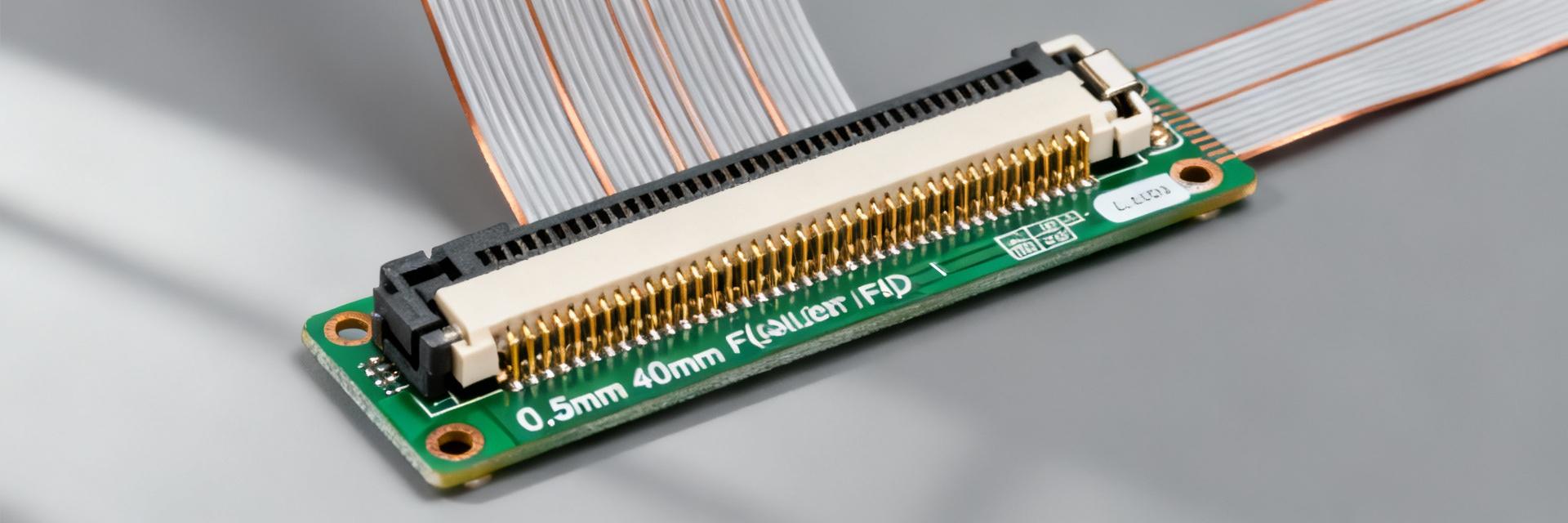
Core identity & key attributes to note
Point: The 0541324062 is a 40-position, 0.5 mm-pitch FFC/FPC style connector intended for right-angle surface-mount installations with bottom contacts. Evidence: Part families match this description for ribbon insertion from the mating plane. Explanation: Check pitch (0.5 mm), position count (40P), and mounting style before footprint work.
Typical product family uses and target applications
Point: FFC 0.5mm connectors are favored where routing density and compact mating length are required. Evidence: Common targets include TFT/OLED displays, camera modules, and handheld controls. Explanation: 40P specs map well to short parallel buses where signal count and small pitch balance routing.
Data Deep-Dive: Complete mechanical specs at a glance
Dimensional & footprint essentials
Point: Key numeric checks prevent footprint errors. Evidence: Nominal values: pitch 0.50 mm (0.020"), 40 positions, 0.30 mm FFC thickness, height ≈ 2.00 mm. Explanation: Use the table below for land pattern notes.
| Dimension | Nominal | Tolerance | Unit | Land Pattern Notes |
|---|---|---|---|---|
| Pitch | 0.50 | ±0.05 | mm | Stagger keepouts for solder fillet |
| Positions | 40 | — | Pins | Verify pad count and pad length |
| FFC thickness | 0.30 | ±0.05 | mm | Specify thickness in assembly docs |
| Height above PCB | ≈2.00 | ±0.10 | mm | Allow 2 mm clearance for right-angle mate |
Materials, flammability & compliance tags
Point: Housing compound and plating determine service environment. Evidence: Typical housings are thermoplastic (UL 94 V-0) with nickel and gold flash plating. Explanation: Confirm flammability for end-product class and gold thickness for low resistance.
Data Deep-Dive: Electrical & performance specs
Voltage, current, contact resistance, operating temperature
Point: Electrical limits bound safe use. Evidence: Datasheet values: ≤50 V, ≈0.5 A/contact, Explanation: These set design limits for power traces and thermal derating.
Reliability metrics & lifetime
Point: Mechanical life and retention matter for serviceability. Evidence: Small FFC connectors specify low hundreds of mating cycles; retention forces are defined per spec. Explanation: Plan tests for mating cycles, durability, and vibration.
How-to / Design Guide: PCB footprint, assembly & soldering best practices
PCB footprint and mechanical anchoring
Point: Small pads require precise land patterns. Evidence: Solder mask-defined pads, controlled sizes, and mechanical anchors are recommended. Explanation: Check pad XY size, mask openings, and 2 mm clearance.
Reflow, soldering and pick-and-place notes
Point: Reliability depends on profile control. Evidence: Use Pb-free reflow, 30–60% stencil aperture, and set fiducials. Explanation: Mitigate bridging and tombstoning by balanced pad geometry.
Comparisons & use-cases: 0541324062 vs alternatives
| Criteria | 0.5 mm 40P (this class) | Alternate (vertical/1.0 mm) |
|---|---|---|
| Pitch | 0.5 mm | 1.0 mm |
| Positions | 40 | 40 (or scaled) |
| Mounting | Right-angle SMD | Vertical through-hole or SMD |
| Height | Low (~2.0 mm) | Taller (varies) |
| FFC thickness | ~0.30 mm | 0.2–0.5 mm options |
Example application scenarios
- • Small LCD interface: 40P and 0.5 mm pitch fits parallel RGB or MIPI signals with minimal board real estate.
- • Camera module cable: Dense signals, short run; verify controlled impedance if high-speed lines are used.
- • Compact sensor array: Multiple channels in a single ribbon; reduces footprint but requires careful routing.
Actionable checklist: Sourcing, verification & production QA
Pre-order checklist for engineers ▾
- Verify exact part number and cross-reference the dimensional drawing; confirm pitch, positions, and mounting orientation.
- Confirm mating cable thickness and plating; request ESD-safe reels for pick-and-place.
- Request datasheet pages for mechanical drawings and recommended land pattern before ordering.
Prototype test plan & mass-production sign-off ▾
Proto tests: Continuity verification, 50–100 mating cycles, vibration per product class, and thermal cycling.
Pass criteria: All contacts within resistance spec, no intermittent opens, no solder joint cracking.
Sign-off flow: Prototype → Pilot run with first-article inspection → Production ramp with sampling QA.

