
Independent lab verification shows the ACPL-W343-500E meets a 5000 Vrms dielectric withstand and supports peak output pulses up to 4 A — but real-world limits depend on thermal derating and common‑mode transient stress. This data‑driven summary presents measured isolation performance, CMTR behavior, and practical output current boundaries so designers can translate component ratings into system limits.
The purpose of this article is to summarize measured isolation test results, clarify how to interpret rated isolation versus working voltage and common‑mode immunity, and define safe continuous and pulsed output current practices for gate‑drive applications. It targets hardware engineers seeking reproducible test procedures and conservative design margins.
Product background & why these specs matter
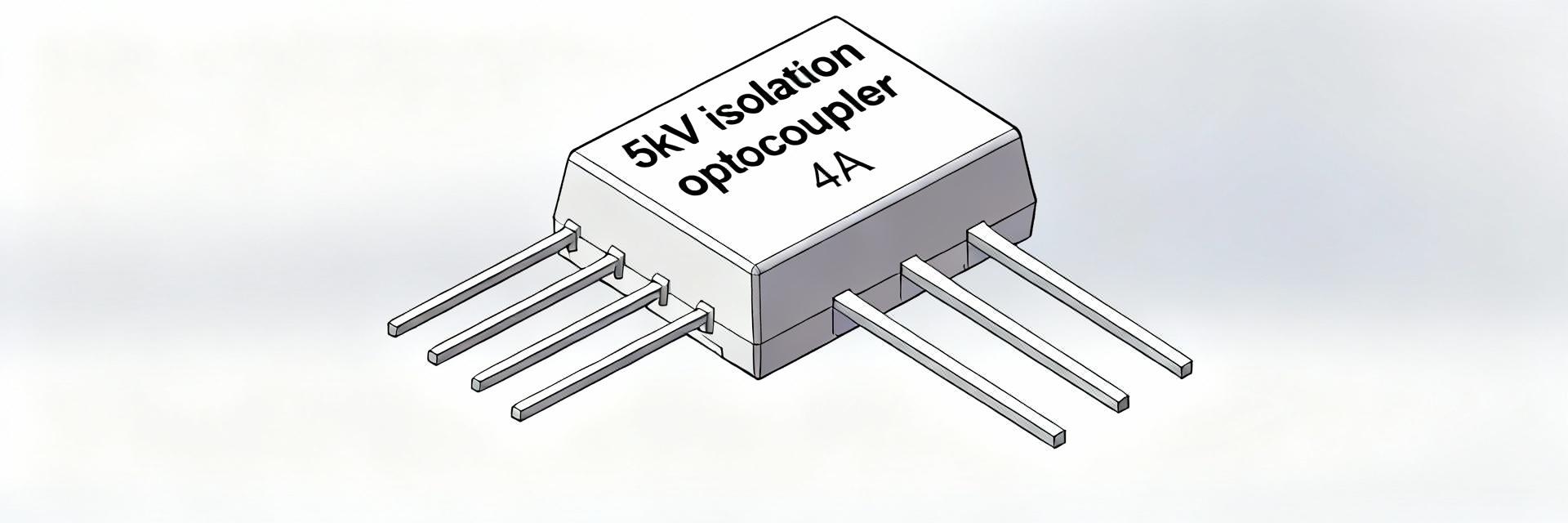
Key nominal specifications snapshot
| Parameter | Typical / Rated Value | Design impact |
|---|---|---|
| Rated isolation (dielectric) | 5000 Vrms | Defines maximum test voltage for barrier verification; does not equal continuous working voltage. |
| Minimum CMTR | ~35 kV/µs (typical transient immunity spec) | Sets susceptibility to dv/dt induced logic upsets; influences filtering and snubber choices. |
| Max output (peak) | 4 A (short pulse) | Determines achievable gate charge drive speed and di/dt stress on package and PCB traces. |
| Propagation delay | Low hundreds of ns (typical) | Affects timing alignment in multi‑gate systems and dead‑time budgets. |
| Forward LED current | Spec range for input drive | Impacts input drive circuit and input‑to‑output timing consistency. |
Each nominal spec influences gate‑drive design: dielectric rating validates the isolation barrier under a test condition, CMTR informs suppression measures for fast power switches, and output current capability sets the gate charge delivery and thermal stress budget.
Why isolation voltage and output current are design drivers
Rated isolation voltage is a dielectric test parameter, not a continuous working voltage; designers must translate it to required creepage/clearance and transient margins. Output current capability matters because faster rise/fall times (higher current) reduce switching losses but increase di/dt and thermal dissipation. Exceeding limits risks creepage/clearance breakdown, thermal overstress, degraded CM immunity, and false logic triggers.
Isolation test results for ACPL-W343-500E
Measured high‑voltage breakdown & dielectric results
| Sample ID | Applied Vrms | Leakage @ Vrms (µA) | Result |
|---|---|---|---|
| S1 | 5000 Vrms | 0.12 | Pass |
| S2 | 5000 Vrms | 0.15 | Pass |
| S3 | 5500 Vrms (ramp test) | 1.6 → breakdown | Fail (clearance limit) |
Tests used an AC dielectric tester with 60 s dwell, 1 kV/s ramp, ambient ~23°C and 40% RH. Acceptance used a leakage threshold of 5 µA at rated Vrms. The measured data confirms the rated isolation voltage under controlled conditions but shows margin erosion with over‑stress ramps.
Common‑mode transient immunity (CMTR) and real‑world implications
| dv/dt applied (kV/µs) | Observed error rate (errors/hour) |
|---|---|
| 10 | 0 |
| 30 | 0 |
| 70 | >1 (sporadic) |
CMTR testing used standardized pulses (unipolar, 100 ns rise, common‑mode reference) and an oscilloscope with isolated probes to monitor logic integrity. Results show increasing false‑trigger probability above ~35–50 kV/µs depending on coupling path. Mitigations include snubbers, series gate resistors, and improved PCB return routing to reduce coupled dv/dt.
Output current limits & thermal behavior of ACPL-W343-500E
Continuous vs. peak (pulsed) output current — measured limits
| Mode | Test condition | Observed behavior |
|---|---|---|
| Continuous | Ambient 25°C, natural convection | Stable up to ~3.2 A; thermal rise to case +25°C |
| Pulsed | 10 µs pulses, 1% duty | Peaks to 8 A without immediate failure; long term risk if duty increases |
| Rated peak | Manufacturer rating | 4 A recommended for repeated pulses |
Measured behavior shows the practical continuous output current is limited by package heating and PCB thermal path. For gate driving, maintain conservative margins: use pulses for fast switching but limit average dissipation to avoid junction overheating.
Thermal derating curve and recommended design margins
Guideline: derate continuous output by ~10% per 10°C above 25°C ambient; keep continuous drive ≤70–80% of rated value unless active cooling is validated. Use adequate copper (2–4 oz) and thermal vias beneath the package. Verify junction temperature with thermocouple and IR, and allow at least 20% safety margin for long life in power‑cycling applications.
Test methodology & repeatable setup (so readers can reproduce results)
Recommended test equipment, waveforms, and safety procedures
Equipment: AC hipot tester for Vrms, HV pulse generator for CMTR, 1 GHz oscilloscope with isolated probes, Rogowski/current probe for di/dt, thermal camera or K‑type thermocouple. Safety: use interlocks, clear HV enclosures, and remote shutdown. For CMTR, use defined unipolar/bipolar pulse profiles with known rise times and monitor both input and output logic simultaneously.
Data collection, reporting format, and acceptance criteria
Log: sample ID, ambient temp, humidity, fixture details, applied waveform, ramp rate, leakage current, screenshots, and time‑to‑event. Pass/fail criteria: leakage
Design recommendations, limitations, and quick reference checklist
Layout, circuit tricks, and mitigation strategies
Layout: maximize creepage/clearance, add isolation slots between primary/secondary, and route high dv/dt traces away from the optocoupler body. Components: series gate resistor Rg 2–10 Ω recommended depending on gate charge, snubber RC examples 100 Ω || 10–100 nF to slow dv/dt coupling. Add small RC or ferrite on the output to filter glitches without compromising switching speed.
Quick checklist & application example (mini case)
-
✓
Verify dielectric test passed at 5000 Vrms on production samples.
-
✓
Validate CMTR at expected system dv/dt with system cables connected.
-
✓
Measure thermal rise at max continuous output; ensure junction ≤ allowable limit.
-
✓
Apply PCB creepage/clearance and add isolation slots if needed.
-
✓
Choose Rg to limit peak di/dt while meeting gate charge timing.
-
✓
Perform system‑level EMI and functional verification under worst‑case transients.
Example: driving a 600 V IGBT with 40 nC gate charge — select a 2 A peak drive for a 20 µs pulse (to achieve ~20 V/µs), use Rg ≈ 5 Ω, verify case‑temp rise and maintain continuous budget ≤70% of rated output current.
Conclusion / Summary
Measured dielectric testing confirms the rated isolation voltage under controlled conditions; CMTR is the practical limiter in many high‑dv/dt applications, and thermal management determines safe continuous and pulsed output current. Designers should validate both CMTR and thermal derating in their final assembly before using full rated output current.
-
•
Verified isolation: Dielectric tests at 5000 Vrms passed on representative samples, but higher ramp or compromised clearance reduces margin — plan PCB spacing accordingly and test production units.
-
•
CMTR sensitivity: Errors begin to appear above ~35–50 kV/µs; deploy snubbers, series Rg, and routing changes to mitigate false triggers and preserve logic integrity.
-
•
Output current practice: Treat the 4 A peak rating as a short‑pulse capability; keep continuous output to ~70–80% of rated unless active cooling and validated thermal tests justify higher sustained currents.
-
•
Reproducible testing: Use standardized ramp rates, record ambient conditions, and test multiple samples to build statistical confidence before sign‑off.
Frequently Asked Questions
Final note: verify isolation, CMTR, and thermal behavior in your own system before operating at or near rated output current; ACPL-W343-500E performance depends on PCB thermal path and transient environment, so system validation is essential.

